Organ Theory
Simple Organ Theory
21 September 2026 · 12 min read
An introduction to the Simple Organ Theory, its elements, tissues, humours, diagnostic observations and treatment principles.
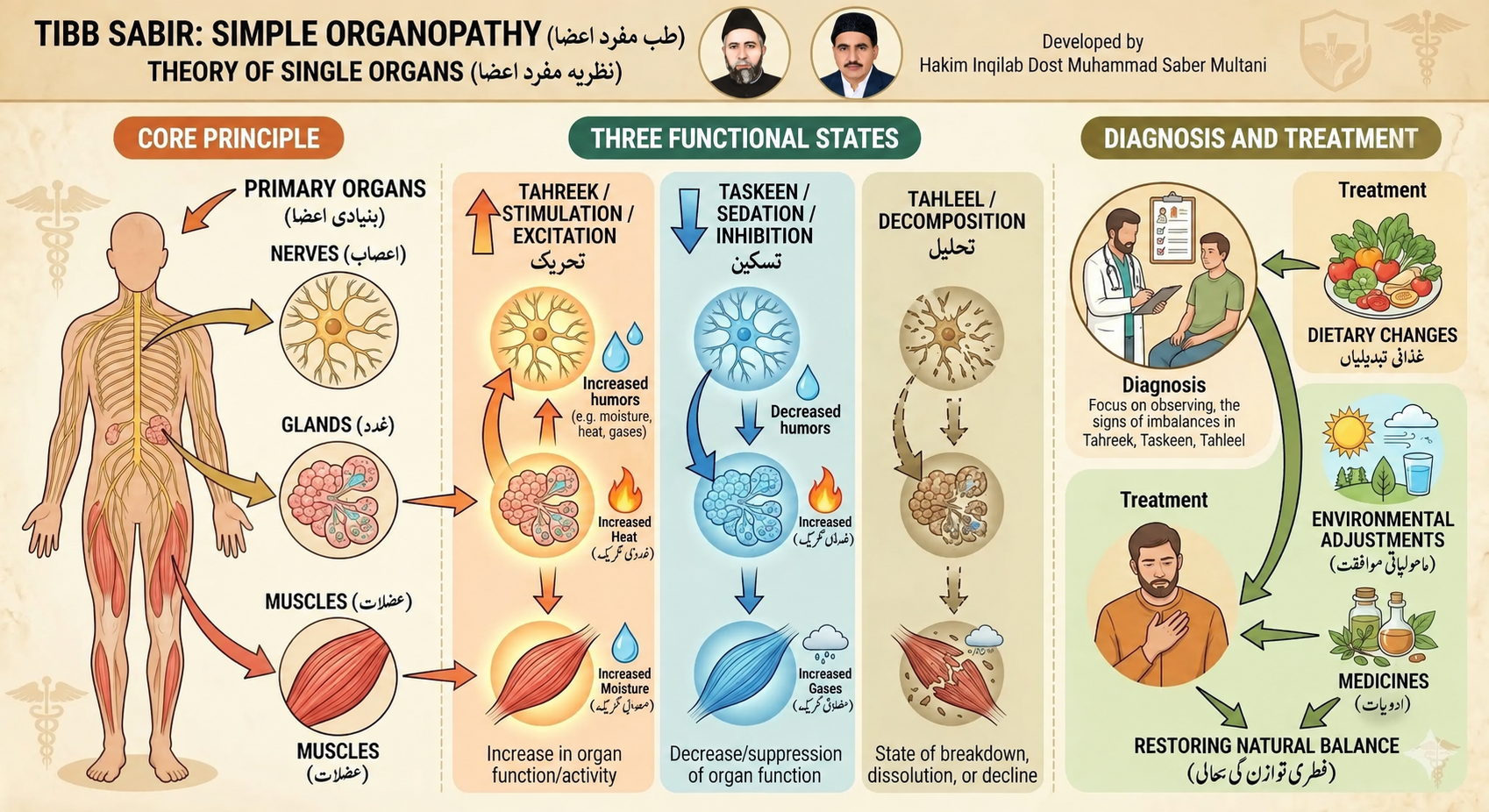
The Simple Organ Theory is presented as a medical system developed by Dr Dost Muhammad Sabir Multani in the 1950s. The source places it alongside Greek, Islamic, Ayurvedic and Chinese traditions that seek to preserve health and improve the condition of people with health challenges through food and lifestyle.
According to the source, Dr Sabir Multani wrote 20 books and more than one hundred papers to support and define the theory. Hakim Muhammad Sharif Dunyapuri was one of its early students and later introduced and published the theory more widely, writing 16 books on different aspects of medicine.
The theory relates the four elements of the universe - air, fire, water and earth - to human anatomy, herbs and foods. It also gives principles for specific food charts intended to support the action of herbs.
The human body is described as being composed of muscular, epithelial, nervous and connective tissues. The first three tissues combine through connective tissue to form compound organs such as the stomach, intestine, heart, liver, eyes and lungs. The source places the root cause of disease in the basic tissues or life organs and describes treatment as balancing body systems and supporting a sedated organ through particular foods and herbs.
The source describes the heart as the centre of mesodermal muscular tissues, the liver as the centre of endodermal epithelial tissues, and the brain as the centre of ectodermal nervous tissues. These tissues combine to form compound organs, which can be grouped according to the tissue that predominates.
It describes involuntary muscles, such as cardiac and intestinal muscles, and voluntary muscles controlled by the body. It also distinguishes sensory neurons, which receive and transmit messages to the brain, from motor neurons, which carry orders from the brain to muscles. The source further describes glands that purify and excrete fluids and glands that absorb and chemically change fluids.
Disease is explained as malfunction of a basic body system after a change in the proportion of humours in the blood. The source names black bile, yellow bile and phlegm, and relates the muscular, endocrine and nervous systems to different humoural conditions and classifications of disease.
Pulse is given a central diagnostic role, along with examination of urine and tongue and consideration of laboratory tests. Pulse examination is described through six observations: depth, length, volume, speed, pressure and tension.
The treatment principle is based on hyperactivity of a life organ and the corresponding sedation or lethargy of the other systems. The source describes supporting the sedated organ and harmonising the systems with specific food and herbs. It gives separate examples for hyperactive muscular, endocrine and nervous systems and the food and herbs intended to support the related sedated system.
Food is described as especially important in chronic conditions. The source says that herbs without a specific food chart produced slower recovery in chronic problems, while acute symptoms may require herbs promptly while food is still taken with caution. It uses cholera and damp food as an example of the need for dietary care.
The conclusion calls for continued research and broad discussion among medical disciplines. The references include works by Hakim Muhammad Sharif, Dr Dost Muhammad Sabir and a text on Chinese herbal medicine.